
Counting Backwards

Thanks to my newfound enthusiasm for Pixies' Surfer Rosa in 1988, I soon afterwards became aware of  Throwing Muses, the two labelmates often being mentioned together in the music press. The next year I bought the latter band's third album Hunkpapa, only to find it easier to admire than enjoy. It wasn't until '91, and The Real Ramona (album #4), that I properly became a fan. The opening track 'Counting Backwards' was my favourite of its songs.
Decades later & with those cassettes long gone, I was intrigued, ca. 2018, to find a vinyl copy of The Real Ramona in a Chepstow charity shop. I couldn't see a price on it, so queried the cashier who shrugged and suggested £2, which seemed like a bargain. On getting it home I found there was a price sticker, but inexplicably affixed to the inner sleeve where neither of us had seen it: £12. Having been briefly pleased at landing a good deal I then felt bad at having snatched a tenner from the hands of the needy. I later made a donation to assuage my conscience.

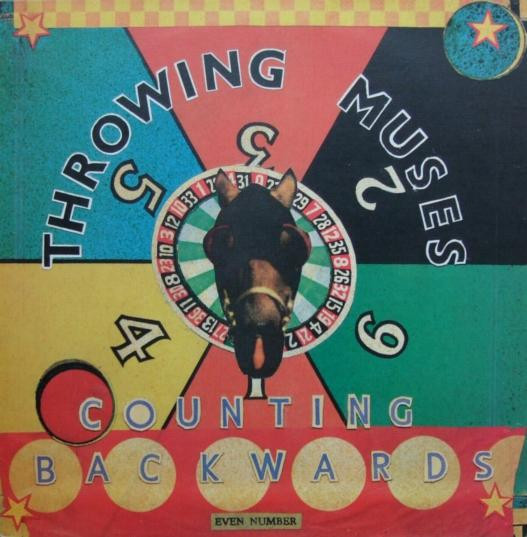
Last year, same town, different charity shop, I picked up this 'Counting Backwards' 12" EP. After the title track on side A is a terrific version of 'Amazing Grace' in which the band were joined by Joe Harvard playing lap steel guitar. Side B gives us two more fine songs in the shape of 'Same Sun' and 'Cottonmouth', neither of which would - in my estimation - have been out of place as album tracks on The Real Ramona.

Comments

Popular posts from this blog

Complete String Quartets

While the string quartets of Nikolai Yakovievich Myaskovsky (1881-1950) were all published in the Soviet era, a few of them had pre-revolutionary origins. Two quartets he wrote in 1911 and '09 while a conservatory student re-surfaced some twenty years later designated as Quartets Nos. 3 and 4.  An even earlier "schoolboy" piece was later re-worked more radically as Quartet No. 10, premiered in 1945. Myaskovsky partook of an ample share of the turmoil and tragedy of his times: he was wounded and shell-shocked after service on the front line in World War I, and his father, who had been a high-ranking military engineer, was brutally murdered by a revolutionary mob. Despite that, his music, even at its most sombre, hasn't the black bile or biting sarcasm of Shostakovich's, or of his friend Prokofiev's. Of the works collected here, in excellent early '80s performances by the Taneyev Quartet, only Quartet No. 1 has any significantly metallic tang of early S...

Ein Schattenspiel, etc.

Georg Friedrich Haas is a contemporary Austrian composer of "art music". "Haas's style recalls that of György Ligeti in its use of micropolyphony, microintervals and the exploitation of the overtone series; he is often characterized as a leading exponent of spectral music" says wikipedia. Only a relative few of his many compositions have been issued on CD - many more of them can be found on YouTube. On this 2020 disc are three of his works in which standard classical instrumentation is augmented and altered by "live electronics". Two are string quartets and one is for solo piano. Is a string quartet still really a quartet if there are meanwhile some other people with laptops busily twizzling the sound? There is a live performance video of the 'String Quartet No. 7', the first work on the disc, where the JACK Quartet are supplemented by a trio of sound boffins to realise the composition. Whether it's properly a quartet or a septet is neithe...

Influencías

In my original blogging days, I would occasionally run giveaways to offload unwanted books or CDs to whomever claimed them. Sometimes the recipients would offer to send me something in return. It was in this way that, ca. 2007, a Catalan correspondent sent me Influencías: a CD of perfomances by the Barcelona-based Cuarteto Casals. The CD begins with Maurice Ravel's renowned string quartet: I hadn't known the piece before receiving this disc, but I was sold on it by this fresh & bright performance. Next is a quartet called 'Vistes al Mar' by the Catalan composer Eduardo Toldrá. Its evocative maritime movements are prefaced by recitations of poems by Joan Maragall, a Catalan author whose works directly inspired the piece. Lastly there's an arrangement of Joaquín Turina's atmospheric 'Oración del Torero', originally composed for a lute quartet. I'm on the fence about the cover photo: it's a well-composed picture & not a bad idea, but with 2...